In this sequence of images, I explain the ideas that guided me in creating the workshop I'll be teaching on Madeline Island next July!
For more information check this link.


In this sequence of images, I explain the ideas that guided me in creating the workshop I'll be teaching on Madeline Island next July!
For more information check this link.
I am very glad to announce that I will be at the Madeline School of the Arts again in July 2025!
This is so exciting! I love the time I spent on stunning Madeline Island, in the charming and cozy environment of the school's campus.
Cheers to our 2025 course!
Urban Sketching and Beyond: Solid Foundations, Exciting Application
.jpg)
The same team will be reunited: me, Oliver Hoeller, Nina Johansson and Jane Blundell. We had a great time as friends and teaching together.
Don't waste your time and go check and apply to this incredible course on this link!
This time, I will be teaching a workshop titled:
"Visual Reading - Using your Perception to Build Scenes"
The goal of this workshop is to develop tools and approaches to create a drawing of a building and its setting, with character and atmosphere.

It is based on a perceptive approach to perspective, measurement, proportions, depth and tones.
 We will be using the school's beautiful buildings for our studies. There is a charming little storage building that is perfect for exploring perspective and visual measurements. Additionally, there's a good-sized barn with great character (where we enjoy our incredible meals!) that will serve wonderfully as the main subject. Of course, the subjects can change, as there are many aspects to consider while on location.
In addition to nature (especially trees, which is the topic for the 2024 season), I love drawing buildings, as well as exploring architecture and drawing techniques.
This time, I will use all my knowledge to help students improve their skills in creating scenes that involves buildings.
This is how my workshop will unfold:
Morning session
During the morning, we will study, and practice basic concepts related to drawing a scene. We will review the main aspects of perspective both in class and on location, creating small line drawings. Then, we will learn how to measure angles and distances on-site so that we can begin to compose a scene. We will draw some of the charming buildings on the school campus.
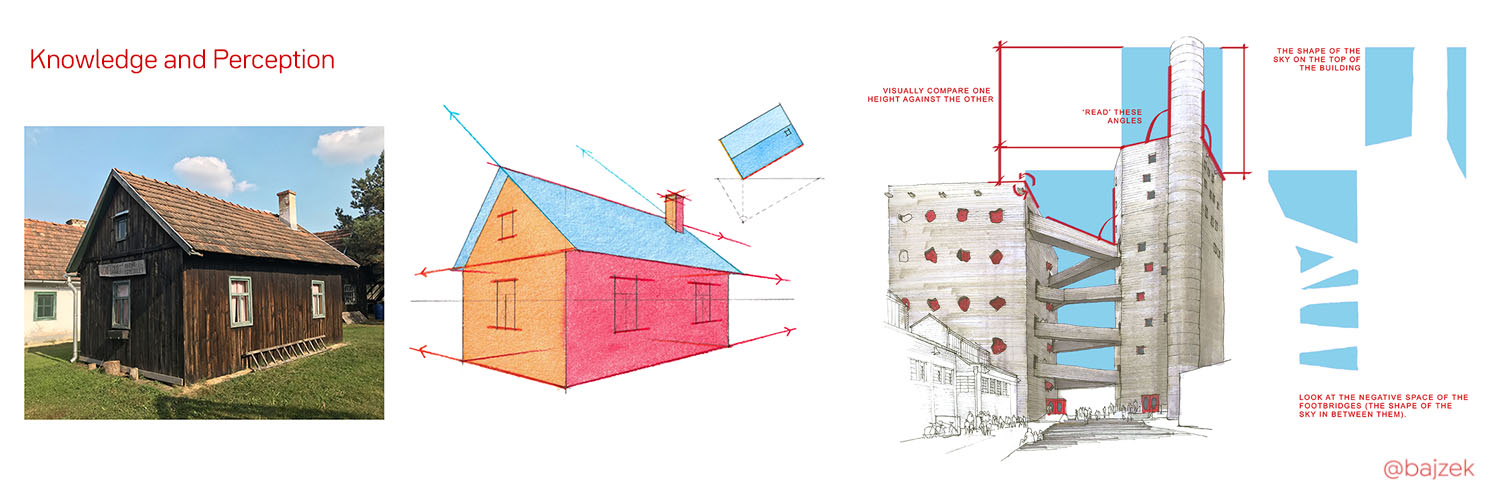
Afternoon session
We will start a larger drawing using pencils and/or pens on toned paper. First, we will ensure that the subject fits on the paper and determine how much space will be left for the surroundings. To add character, we will apply white pastel and colored pencils on toned paper to create sophisticated effects.
Below you will find a few examples of this topic.


During my time in the US, my focus was always on trees, as they were the main subject of most of my activities.
Following my attempts to find a perfect subject for my classes I went "tree-hunting" around the school premisses (as I told here) and around the island. One subject that stood out was an old weeping willow, by the entrance of the Madeline Island Golf Club. I went there with Jane Blundell to sketch it, but due to the rain, we sketched from inside the car.
The sketch I did there share some similarities with another one I did later in Seattle. I believe this is due to the focus on the branch system.
In both drawings I used graphite and white pastel Cretacolor pencils and erasers.
 |
| The old weeping willow, seen from inside the car |
 |
An old tree in the Seattle Arboretum, particularly the branch that extends straight out from the trunk caught my attention - it seemed oddly unnatural. |


Great news!!
I am pleased to inform you that I will share my approaches and techniques at Madeline Island School of the Arts, in July 2024!
I will be together with a few fantastic international sketchers: Jane Blundell (Australia), Oliver Hoeller (Austria) and Nina Johansson (Sweden). Participans will sketch with each of us at different new locations daily (check their website and see how impressive the place is!)
The 'Sketching Haven: A Summer Retreat with Four Internationally Renowned Artists' (link here) will happen on July 8th–12th, 2024

"Experience an unparalleled opportunity to enhance your artistic skills with four exceptional instructors. Eduardo Bajzek‘s workshop focuses on capturing trees and landscapes, while Jane Blundell’s workshop specializes in color and botanical sketching. Oliver Hoeller guides participants in telling the story of Madeline Island through sketching, and Nina Johansson immerses you in everyday life in coastal harbor town. With diverse techniques and personalized guidance, these workshops offer a comprehensive learning experience for participants to refine their skills and explore various aspects of sketching and painting. Students will interact with a new instructor and visit a new location everyday."
I will teach the following workshop:
Eduardo Bajzek: Trees and the Island Landscape

Morning Session:


And here's a short description of my fellow partners (see more at Madeline's website):
Jane Blundell: Botanical Sketching
Jane is a member of the Australian Watercolour Institute, Australia’s oldest watercolour society, and an exhibiting member of the Royal Art Society of New South Wales, and a member of the Urban Sketching education committee. She is passionate about watercolour, colour, drawing and sketching.

Oliver Hoeller: Sketching the Story of Madeline Island
Oliver is a skilled sketcher and traveling artist, known for his ability to tell rich stories through his work. Explore Madeline Island, visiting the museum and surrounding areas to gather visual elements that reflect the island’s fascinating history. Oliver provides personalized guidance on arranging elements on the page; presenting demonstrations and giving feedback throughout the day.

Nina Johansson: Everyday Life in a Coastal Village
Nina Johansson, an illustrator and art teacher from Stockholm, Sweden, is a dedicated on-location sketcher with a penchant for capturing everyday life in urban environments. Learn techniques to convey perspective without construction, work from big shapes to smaller details, and create well-composed sketches. Students will grow through individual support and group discussions.

On April 19th, the Urban Sketchers Symposium instructor's team had the great opportunity to visit "Papakura Marae", a Maori complex near Auckland, in which the temple (wharenui) was inaugurated in 1990. During the short journey to the place, we learned a song from local organizer Eric Ngan (who arranged the tour) to be sang at the temple as a gift to the Maori people.
We then attended to a beautiful ceremony, with touching music performed by the Maori people. They weren't dressed traditionally as one could imagine as it wasn't a presentation for tourists, which made the moment even more remarkable.
After the ceremony was finished, we had a nice meal and had some time to do a sketch, even inside the temple, where I did mine.
I sketched a carving called Tamatea Pokaiwhenua, a leader navigator who arrived in New Zealand in 950 AD. A hill dedicated to leader is called:
"Te taumatawhakatangihangakoauaupukepikimaungahoronukupokaiwhenuakitanatahu", which means "Tamatea played his flute to lure his young lover to climb the hill without slipping as he waited and prepared a meal for them to share and make love".
Isn't that beautiful?
Later that day, I did a sketch of the city hall. I was a bit distracted by the skateboarders across th street. The weather was changing constantly which was a presage of the rain we got during the symposium. I wanted to make a loose watercolor as I did of the same Queen St. the day before, but I couln't, and I'm not sure why.


On a sunny afternoon, before the symposium started, I went to the Sky Tower, a stunning construction that takes you up to 186 meter high and has lots of attractions.
I went there because I love being at heights, in first place. I didn't know I would have enough time plus find a good spot to sketch. But I did, even though I had to gave up of a first attempt because someone bumped into me, causing me to make a scratch on the paper - fortunately it was at the beggining! I just turned the page over and restarted...
Anyways, I did a very quick sketch for my standards, with a ballpoint pen.


Actually, this was the first drawing I did (or start) in Auckland. The Auckland University Clock Tower was one of the subjects entitled to be part of my workshop location, so I went there asap to check it out and do a few sketches.
I started observing the location, figuring the best spots to sit and draw. Unfortunately, the botton of the building was hidden by renovation works - even if it wasn't, I would have trouble to see it properly due to the cars parked across the street, right in front of me. If I moved a few meters to one side, there was a pedestrian passage; to the other side, a big tree blocked the view. So, I sat down and started - urban sketching is as unpredictable as my cat.
After struggling for an hour, I already realized that subject wasn't the best for my workshop - the building was sooo complicated, with its forms melting into each other (the corners were all somehow disguised). There were dozens of pinnacles in this mixture of Tudor and Flamboyant 19th century bulding. Too hard. I mean, that was an interesting challenge...and as I wrote down on my page : "it's not about the bulding, it's about the scenery".
I also wrote:
"The pinnacles get all messy" (one couln't easily understand where they did belong to);
"Suggesting vegetation" (so I did);
"Looking for the sillhouete" (the whole body of the building);
"Inside shapes can be open" (so the eye doesn't stop everytime).
The mind wanders and we learn a lot, each drawing.
Eventually, I decided to prevent the parcipants from suffering from that intricate (however interesting) tower.
Last April, I went to New Zealand to join the 11th Urban Sketchers Symposium, in Auckland. That was the first post-covid international symposium. We were all missing them.
I was one of the instructors - it was my fifth time teaching at one of them! Although I gathered quite some experience as an instructor, it seems that it was my first time again - it never gets old! It's a big responsability to teach at a symposium. People are so eager to learn something from us!
Well, I arrived in Auckland 5 days earlier to acclimatize and to get myself well prepared for the 3 workshops plus one demo. I went to my location 3 or 4 times and sketched there in a variety of point of views, trying to find the best spot to do my demos and for the students as well.
Before showing the sketches I did on this location, I will share the ones that are already scanned. There are lots of histories and sketches to come. I hope I can keep up with it.
I woke up very early one day and decided to do a quick watercolor sketch near the hotel. There was a beautiful 3-story building around the corner at Queen St. I sat down and sketched it for 40 minutes, drawing and painting. I thought I needed that - doing a quick sketch, just to prove to myself I could!


Aquarela feita com base em fotografia que eu tirei em um terreno baldio em frente de casa. Eu gostei de chamá-la "Epidermes", pois registra as diferentes camadas das alvenarias deixadas expostas quando das demolições. São peles envelhecidas, peles raladas, expondo seus músculos e suas histórias.
Além da parte, digamos, poética, me interessa o arranjo de superfícies, texturas e cores.
Aquarela sobre papel Arches, 32 x 22 cm (área da mancha).


 |
| O desenho feito no local, durante 2 horas. |
 |
| A continuação do mesmo, alguns meses depois, com mais texturas e algumas sombras. Adicionei também o lettering. |
 |
| O desenho concluído, colorido com aquarela. |


