23 setembro 2025

Notes on Perspective Classes

As you know, I taught perspective in my last course at Madeline Island, this past summer. I've been reflecting on my experience and here are some notes:
  • Most people seemed to understand the main concepts of perspective, but a few struggled with the idea of projecting a scene onto a picture plane. Interestingly, even among those who struggled, some completed the classroom exercises correctly - likely because they were following the script or formula I had just given them, rather than fully grasping the concept;
  • It was an especially good idea to emphasize: eye level, the line of sight, and the picture plane;
  • The ‘colored box’ helped A LOT!
  • Lifting and showing my drawing while working on the demos proved to be both important and necessary;
  • The placement of the vanishing points, as well as the distance between them, seemed to be a particularly challenging issue;
  • It is essential to emphasize that lines are either horizontal, vertical, or receding toward the vanishing points. Some people forget this and ended up drawing lines that head off to strange, random places onto the page. This problem seems to come from a confusion between the picture plane and the observer’s position, as if the observer sees both the drawing and the scene from above (however, this is just a speculation from my part)

02 setembro 2025

Toned paper as a foundation for atmospheric drawings

It hasn’t been very long since I started using toned paper in my urban sketching. I must say, I regret not trying it sooner! It’s just incredible how toned paper can turn any drawing into something much more appealing. I also think it makes the process a little faster, since the middle value is already set — all you have to do is add the darks and the lights.

Well, of course, it’s not that simple 😆. You can easily spend a lot of time building up layer after layer of graphite (or another medium) without really getting anywhere. But once you add the white, the light pops and the full range of values is established. However — there’s always a however — if you bring in the white too soon, it will just get dirty.


As I developed some skills in creating atmospheric drawings with graphite, I thought it would be a good idea to bring this approach to the workshop as well, this time on toned paper. 

To introduce this stage of the workshop, I talked about how artists can develop a deeper level of sophistication by nurturing their sensibility. By “sophistication,” I don’t mean simply refining technique — it’s about adding layers of meaning to your work. To illustrate this, I brought up the American artist Andrew Wyeth, whose works expresses this very idea.


31 agosto 2025

Beyond Vanishing Points: Visual Reading

Knowledge fuels perception, enabling it to grow stronger. This means we cannot bypass studying essential methods—especially linear perspective, which involves a mechanical process. Yes, it requires patience and effort, but studying perspective builds a useful and powerful repertoire—one that can be accessed at any time (or even consciously set aside).

Yet, there is a tool that might help capture the world before us - what I call “visual reading”.

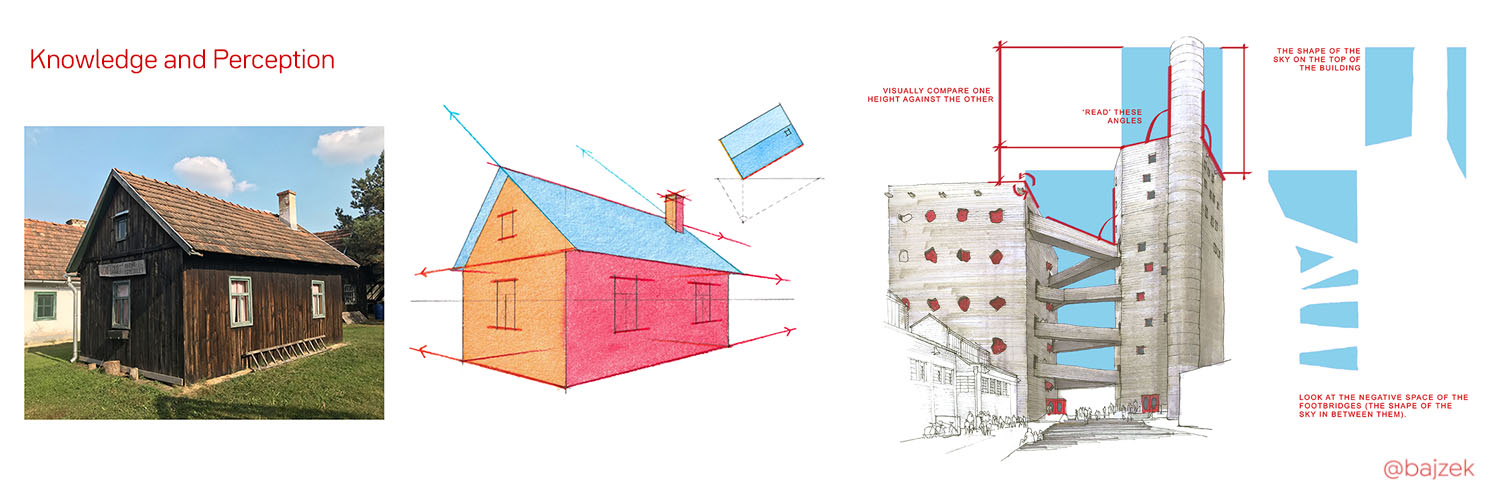
Visual reading is the act of examining and distilling a scene into an organized collection of angles and measurements – or simply, shapes. These two-dimensional elements are geometric abstractions of planes, volumes, masses, or voids inherent in the scene we observe.

When this specific type of perception is well trained, everything can be translated into rectangles, triangles, ellipses, or any nameless shapes. With experience, this act becomes internalized and employed naturally, without effort or taking up much space in our minds – meaning more room for intuition. The more we create a fertile ground for intuition to grow, the more expressive we become.

I decided to use the main building of the school as a subject as well, especially the section shown in the picture beside, which had deliberated left the bottom of the building off the limits of the frame.

Although it looks challenging, this detail provides valuable opportunities to explore the visual reading method, without neglecting key aspects of mechanical perspective, such as eye level, vanishing points, and the nearest edge. 

See in the pictures above the sequence of visual analysis of the subject: first (A), we observe the negative shapes around the bulk of the building, especially around the roof. Second (B), we begin to read the multiple angles against horizontal and / or vertical references. Finally (C), applying our knowledge of linear perspective, we can establish some very important connections (ones we wouldn’t figure out otherwise).

Apart from the workshop’s technical background, I also wanted to share a few ideas to make things more interesting, both in terms of technique and concepts, which I’ll cover in my next post.

Learning Through Demonstrations and Practice

Drawing is the result of a union between knowledge and intuition.


Knowledge arises from learning foundational principles such as linear perspective, tonal range, and color theory. It’s also the outcome of acquiring technical skills, developed through consistent and diligent practice. 

Intuition is the terrain where insight emerges. It involves using our sensibility and nurturing it by absorbing Beauty, whether from nature or other art forms (literature, music, cinema, architecture…) and by experiencing life itself. 

Both these dimensions enhance our visual perception: through study and practice, we train the brain to look beyond common sense or mere facts, infusing new, personal meanings into what we perceive. Seeing negative spaces are a perfect example of this capacity. 

Regarding the foundations, here are examples of demonstrations I did during my classes at Madeline School of the Arts, as posted earlier.


One of the demos I did in the classroom, using the colored box

On-location demo - explanation. I stated that we can keep the same structure while changing the visual field, the format, and the position of the eye level within the frame.

Notice the emphasis on the visual reading aspect on this demo - the shapes on the sky, the angles on the ground.
Below, a few photos of classes:

Everyone brought their stools. On the back, you can see Oliver's class going on 


Our little, beloved barn we used for studying perspective and visual reading. It was the perfect subject!

More students. On the left you can see a woman 'reading' with her pencil. The building behind is the "Milk House", where there are two big, comfortable classrooms. 


23 agosto 2025

Madeline Island School of the Arts - Season 2

This July, as I posted before, the Madeline Island School of the Arts held another course led by a great group of dedicated instructors, including yours truly. 

Once again, it was an incredible week—full of joy and camaraderie, but also challenges and plenty of learning, and of course the awesome food and the beautiful scenery of both the campus and the island.

My workshop was this: "Visual Reading - Using your Perception to Build Scenes" (see here a description)

The results were great, I must say. For those who already had some experience with perspective, it was a good chance to sharpen their skills or simply practice using the personal approach I’ve developed over more than 15 years of teaching. And for complete beginners, it was the perfect chance to jump in, learn, and start experimenting right away. That’s because we were completely immersed in a calm, inspiring setting—starting in the classroom and then taking the knowledge straight outside, just a few steps from the door.


I believe I’ve developed a good balance between the theoretical and practical sides of perspective, especially since I work on a smooth transition from the mechanical system to the visual/perceptive system, making it easier for the students to understand and depict three-dimensional space.

For explaining the fundamentals, I brought along my beautiful little box of colors, which was a huge help - for both indoors and outdoors activities! 

Here are two sketches I made in preparation for the classes. They show the development of my thinking and were used to illustrate, among other things:

  1. Framing: Helps make things smaller so they fit onto the page;
  2. First lines: Eye level, nearest edge—the first lines establish the dimensions of the subject, but can be adjusted until you find the right fit;
  3. Establishing the perspective structure: Add the vanishing points onto the page (I specifically asked them to do this as an exercise);
  4. Measuring distances horizontally first, and then vertically: Use the pencil to gauge proportions;
  5. Check dimensions again: Adjust the frame if necessary and possible;
  6. Start figuring out sloping lines;
  7. As your sketch takes shape, mistakes will pop up—after all, drawing is all about making continuous adjustments until, and this is very important, you fully commit to the new reality you’ve just created and move forward;
  8. The structure is in place—you’ve put in a lot of effort to build everything up. Now it’s time to start adding some details and have fun! (well, I mean, we should be able to have fun at every step of the process of course - I certainly try!)


26 maio 2025

It's coming soon! Urban Sketching and Beyond: Solid Foundations, Exciting Applications

In this sequence of images, I explain the ideas that guided me in creating the workshop I'll be teaching on Madeline Island next July!

For more information check this link.


30 outubro 2024

Urban Sketching and Beyond: Solid Foundations, Exciting Application

I am very glad to announce that I will be at the Madeline School of the Arts again in July 2025!
This is so exciting! I love the time I spent on stunning Madeline Island, in the charming and cozy environment of the school's campus. 

Cheers to our 2025 course!

Urban Sketching and Beyond: Solid Foundations, Exciting Application


The same team will be reunited: me, Oliver Hoeller, Nina Johansson and Jane Blundell. We had a great time as friends and teaching together. 

Don't waste your time and go check and apply to this incredible course on this link! 

This time, I will be teaching a workshop titled:

"Visual Reading - Using your Perception to Build Scenes"

The goal of this workshop is to develop tools and approaches to create a drawing of a building and its setting, with character and atmosphere.


It is based on a perceptive approach to perspective, measurement, proportions, depth and tones.

We will be using the school's beautiful buildings for our studies. There is a charming little storage building that is perfect for exploring perspective and visual measurements. Additionally, there's a good-sized barn with great character (where we enjoy our incredible meals!) that will serve wonderfully as the main subject. Of course, the subjects can change, as there are many aspects to consider while on location.

In addition to nature (especially trees, which is the topic for the 2024 season), I love drawing buildings, as well as exploring architecture and drawing techniques.

This time, I will use all my knowledge to help students improve their skills in creating scenes that involves buildings.

This is how my workshop will unfold: 

Morning session

During the morning, we will study, and practice basic concepts related to drawing a scene. We will review the main aspects of perspective both in class and on location, creating small line drawings. Then, we will learn how to measure angles and distances on-site so that we can begin to compose a scene. We will draw some of the charming buildings on the school campus.


Afternoon session

We will start a larger drawing using pencils and/or pens on toned paper. First, we will ensure that the subject fits on the paper and determine how much space will be left for the surroundings. To add character, we will apply white pastel and colored pencils on toned paper to create sophisticated effects.

Below you will find a few examples of this topic. 


11 setembro 2024

The Apple Tree

After tree-hunting, as I mentioned in my last post, I finally decided on the subject for my classes: an apple tree in the school’s orchard. The tree had great character with its expressive branches (sloping, parallel lines, elbows), beautiful foliage, and a bushy ground underneath. Additionally, it was small and offered good views from different angles. My major concern was the sun, but Oliver helped me to move an umbrella around so we could have some shade.

I was glad that I decided on this tree. It was a great subject indeed, although the foliage wasn't so easy grasp and draw - nevertheless, it provided us a lot of information and insights. My students seemed to really enjoy drawing it!

Here's one of my demonstration sheets:


Here's another one, with some notes:


During the days I spent there, I worked continuously in one piece, allowing me to enjoy the subject, while learning from the process and sharing my insights with the students. The final piece was acquired by the school, which have an amazing collection of art by former instructors - this made me very proud.

Next post, I will talk about the classes!

See you soon ;)

09 setembro 2024

Tree-Hunting

During my time in the US, my focus was always on trees, as they were the main subject of most of my activities. 

Following my attempts to find a perfect subject for my classes I went "tree-hunting" around the school premisses (as I told here) and around the island. One subject that stood out was an old weeping willow, by the entrance of the Madeline Island Golf Club. I went there with Jane Blundell to sketch it, but due to the rain, we sketched from inside the car.

The sketch I did there share some similarities with another one I did later in Seattle. I believe this is due to the focus on the branch system. 

In both drawings I used graphite and white pastel Cretacolor pencils and erasers.

The old weeping willow, seen from inside the car

test
An old tree in the Seattle Arboretum, particularly the branch that extends straight out from the trunk caught my attention - it seemed oddly unnatural.


19 agosto 2024

Tom's Burned Down Cafe at Madeline Island

I believe everyone who steps on the Madeline Island must have a beer or a soda at this funky, hippie bar. Tom's burned down cafe is surviving on the island for decades and has an interesting history behind as you can read in this article.

We went there twice, first on a Friday night, when there was live music and the bar was quite busy. It was one of the funniest bars I've ever been to! I loved the laid-back atmosphere, but what I liked the most was the cool signs! There are dozens of them, hanging around the place, which made me laugh a lot.

We had a great time that night, sketching, drinking and dancing. It was a nice way to relax and sketch, the four of us, together!

Funny sayings everywhere, and lots to sketch

Here's my second sketch, from the outside. The place is so cool to sketch!


And here's my friend's sketches:

Here's Nina Johansson's sketches of the exterior and the interior. Note how she suggested depth in the one above, leaving ink contour only on the bar (the bar is that tent and stuff!). She uses black areas in both sketches to estabilize the drawings, creating visual anchors and an arrangement of two-dimensional pieces - a dynamic pattern

Here's Nina Johansson's sketches of the exterior and the interior. Notice how she suggested depth in the one above, leaving ink contour only on the bar (the bar is that tent and stuff!). She uses black areas in both sketches to estabilize the drawings, creating visual anchors and an arrangement of two-dimensional pieces - a dynamic pattern

This is Oliver Hoeller's sketch. We're sketching side-by-side while having a beer and discussing different approaches to on-location drawing. His drawings always have an animated, exciting feeling


Jane Blundell's sketch shows a beautiful balance between elusiveness and description. The blacks under the tent hold the composition too, and the suggestion of the foliage contrasts nicely with the details of the fence and stuff.


12 agosto 2024

US Trip 2024: Getting to know Madeline Island

Whenever instructors give a course on on-location drawing, we need to scrutinize the place, trying to find its best subjects, points of view, seating places, and shadow availability. That's why I arrived a couple of days before the course began, along with my fellow partners.

We were taken around the island, and I saw several interesting subjects, such as an appealing old willow tree. However, I thought it would be smarter to find a good spot on the Madeline School of the Arts premises, making it easier for the students, close to the classrooms and so on. Oliver and Nina found spots outside, which was part of the general plan, and it worked out very well too - the school took care of the transportation and lunch for everybody.

So, my very first pages filled out in the school were these ones.


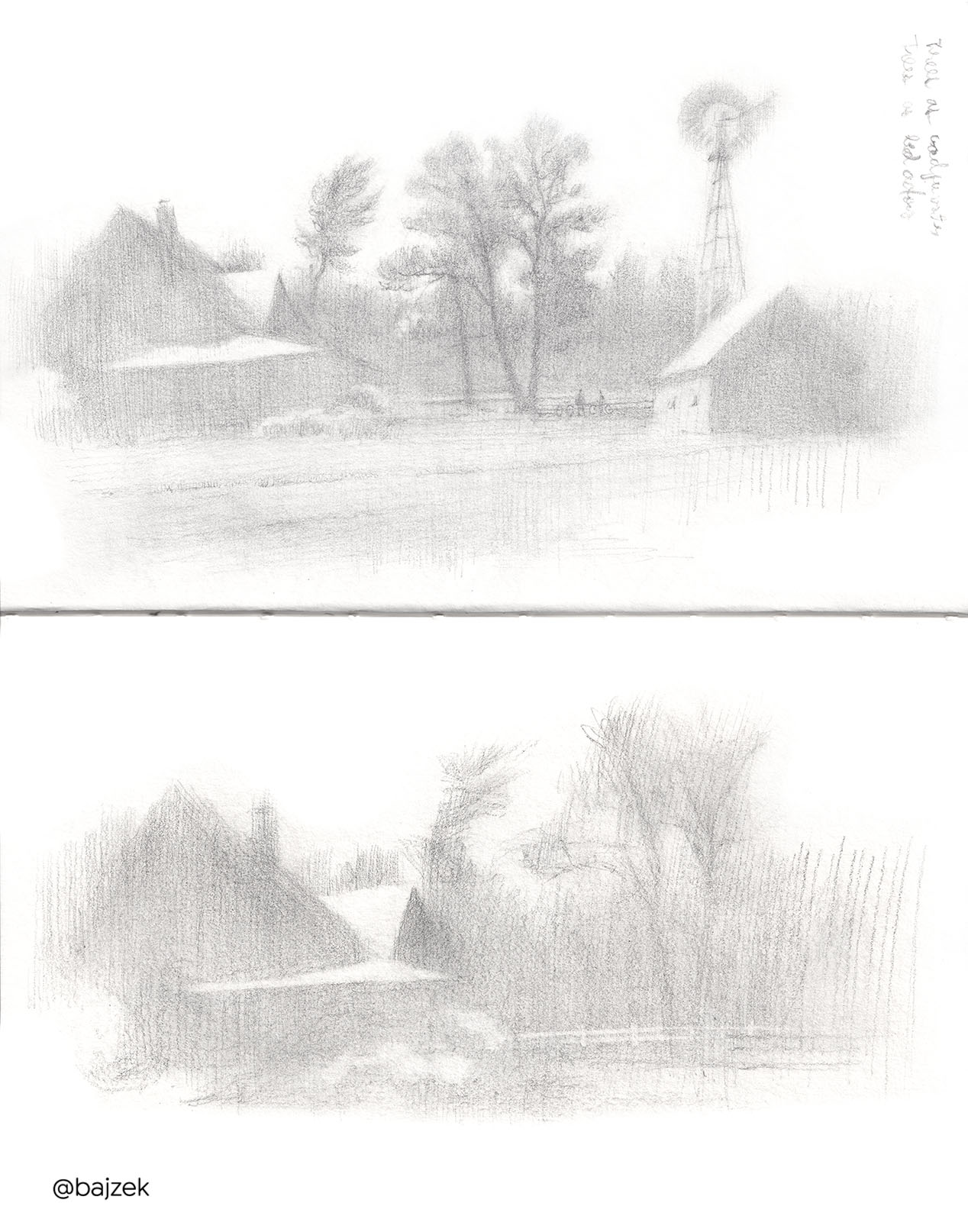
I found this group of trees in between two small houses and the windmill. A compelling subject, with interesting things to be figured out and solved. I used my painterly approach with pencils. 

I recognized that scene could be challenging because there were too many objects to arrange. I instantly realized the windmill could be a very tricky subject in itself - a dark, rounded shape with fuzzy edges against the sky! Some things must be graphically assessed to be figured out, don't you think?

In the sketch on the bottom, I solved the problem by taking the windmill out of the equation, allowing more focus to be put on the trees themselves (the main topic of my workshop).


I tried a few other options, then I thoroughly read up on the subject. I discovered that would be a great subject for a composition workshop, but it might be too much for one focused on trees. I didn't finish these sketches to save time, but I added a few notes that could be interesting to share with the students.

I found a nice subject a 10-minute walk from the school buildings, still within view. It was a beautiful tree by a pond (featured above, on the right lower corner). Very painterly, but a little too wild. I couldn't handle the bugs, so I moved on.

07 agosto 2024

US Trip to US: A Special Gas Station

 That was not about 'a' gas station, but 'the' gas station. 

I rented a car just to see it. There was no public transportation options when I had the time do visit it, so that was my only way. I even considered renting a bike, but it was almost 50km far which was way too much for me.

So, I get there, parked my car and was immediately transported to the 1950's, when the R. W. Lindholm Service Station was built - 1958 to be exact - after a design by Frank Lloyd Wright (1867-1959). As all FLLW buildings, the sense of originality and unity are remarkable. There are always room for new ideas and exploitation. Here, the framing of the rooftops and the long eaves draw your attention.

I took pictures and found a place to sit and sketch. It was sunny, but not too hot (at least by the time I began). So, I sat at the curb, spread my materials and started. 


I wanted to be as accurate as possible, so I build the drawing carefully, especially in terms of proportions and perspective.

The place was closed due to the holidays, but it is still running. I read somewhere that they receive at least half a dozen of people - everyday! I spent 2,5 hours there, and I can confirm that. A few of them came talking to me - a woman said she worked at the FLLW foundation (I think she mentioned Arizona)! As I gave her a postcard, she reciprocated with two awesome stickers! A man got surprised when I said I was from Brazil - he was so kind! He said the most of the city was burned down in a fire in 1918. As he left, I added him in my drawing.

I sketched for around 2 hours. It has hot when I finished, and I was a little anxious because I needed to check out, return the car at the airport and meet Oliver Hoeller.